

A chemical coating remover for removing cured coating on site, without incineration
On a coating line in Thailand, jigs, hangers, and skids build up cured coating. When the film gets thick, dimensions drift. Incineration and a fluidised bed run at about 450°C, and aluminum or a thin spring can warp. Sending the parts out also adds lead time. Coating removal in a tank on site is an alternative to a fluidised bed and to incineration.
FIDEA is an authorized distributor of KAKEN TECH and Zestron. The STRIAL coating remover swells cured coating so it can be removed. Zestron ATRON DC is a water-based coating remover. Both are stocked in Thailand, with support in Japanese and Thai. This chemical coating removal uses no incineration and no chlorinated solvent. It is also an alternative to ethyl acetate wiping. Paint removal and decoating of powder coat, oil-based paint, and EDP film start with a free coating removal test on one or two jigs. STRIAL is held at 60–90°C. ATRON DC runs from room temperature to 60°C. Both are a different control from about 450°C.
What can be removed
Paint jigs
Film stacks on a jig after every coating cycle. A line that removes coating every cycle needs a remover that does not damage the jig. Floors that wipe with ethyl acetate, or another solvent, are part of the comparison.
Hangers
A hanger is thin. If heat bends it, the hanging position moves. Coating removal in a tank on site cuts the trip to an outside shop.
Skids and grids
Skids and grids have a large area and a thick film. Compare immersion coating removal with a method that does not roughen the surface the way shot blast does.
EDP electrodes and fixtures
Once e-coat film insulates an electrode or fixture, current drops. Whether the coating can be removed depends on the paint, so a free coating removal test is the check.
Masking fixtures
Film left on a mating face shifts the next mask. Coating removal on that face without scratching it comes first.
Booth and nearby hardware
Grids and hardware around the booth pick up the same paint. First check whether the part can come off and go into a tank.
Parts before repainting
A defective film on a part can be removed and the part repainted without damaging the base metal. Aluminum needs care by grade.
Compared with the coating removal method you use now
| Method | Heat | Jig distortion | Aluminum, thin parts, springs | Notes |
|---|---|---|---|---|
| Incineration or fluidized bed (outside shop) | About 450°C | Risk | Not suitable | Outside trip, with lead time. No chlorinated solvent. |
| Strong alkali | — | Corrosion | Not for aluminum | No chlorinated solvent. |
| Dichloromethane | — | No | Possible | Uses a chlorinated solvent (rules and odor). |
| Ethyl acetate (wiping or immersion) | — | No | Possible | No outside trip. Done on site. No chlorinated solvent. Fire and organic-solvent rules still apply. |
| STRIAL (swell and remove) | 60–90°C by grade | No | Choose by grade (UM-21U is ○ on aluminum, UM-25U is △) | No outside trip. Done on site. No chlorinated solvent. Outside the organic-solvent, fire, and poison rules. |
| ATRON DC (water-based) | Room temperature to 60°C | No | Check material compatibility before use | No outside trip. Done on site. No chlorinated solvent. The diluted bath is not a hazardous material. The concentrate falls under the fire-service rules. |
Bath temperature depends on the grade. STRIAL UM-21U is 60–90°C, UM-25U is 70–90°C, and ATRON DC is room temperature to 60°C. That is separate from incineration or a fluidized bed at about 450°C.
For sites that wipe off coating with ethyl acetate
Many sites wipe or soak jigs and hangers in ethyl acetate. It is handy, but flammability and vapor control cannot be skipped. STRIAL removes coating by swelling, not by dissolving it, so the following points change.
| Item | Ethyl acetate | STRIAL UM-21U / UM-25U |
|---|---|---|
| Fire Service Act | Class 4, Petroleum Class 1 (water-insoluble). Flash point −4°C | Not a hazardous material under the Act |
| Organic Solvent Poisoning Prevention Rules | Class 2 organic solvent | Not applicable |
| Poisonous and Deleterious Substances Control Act | Deleterious substance | Not applicable |
| PRTR | Not applicable | Not applicable |
| Control on the floor | No open flame, ventilation, and control of the amount in storage | Outside the storage and handling rules for hazardous materials |
| Working temperature | Room temperature | Hold the bath at 60–90°C (UM-21U 60–90°C / UM-25U 70–90°C) |
| The work | Wiping or immersion (it evaporates) | Immerse in a bath so the film swells and lifts |
The ethyl acetate classifications are based on the MHLW "Workplace Safety Site" model SDS (CAS 141-78-6). STRIAL is based on the KAKEN TECH product list (2019). Classification may vary by formulation, so check the SDS of the product you actually use.
Ethyl acetate suits some coatings better. Tell us your coating and jig material, and our free removal test will compare ethyl acetate and STRIAL side by side.
How a free coating removal test works
Removal time changes with the paint and how hard the film is. We take one or two jigs, run a free coating removal test, and send them back.
1. Send the part and the soil, or the FIDEA team visits
Add the paint name, whether the film is cured, and the material (steel, stainless, aluminum). The free coating removal test starts with those two pieces.
2. We remove the coating in a bath and return them
We remove the coating with STRIAL or ATRON DC and return the jigs with notes on the surface and how the film lifted. There is no incineration.
3. We propose the conditions for your floor
We propose the grade and the working temperature.
A free coating removal test can be requested after the list above, in these steps, and from the contact button below. We take one or two jigs, remove the coating, and send them back.
KAKEN TECH STRIAL and Zestron ATRON DC
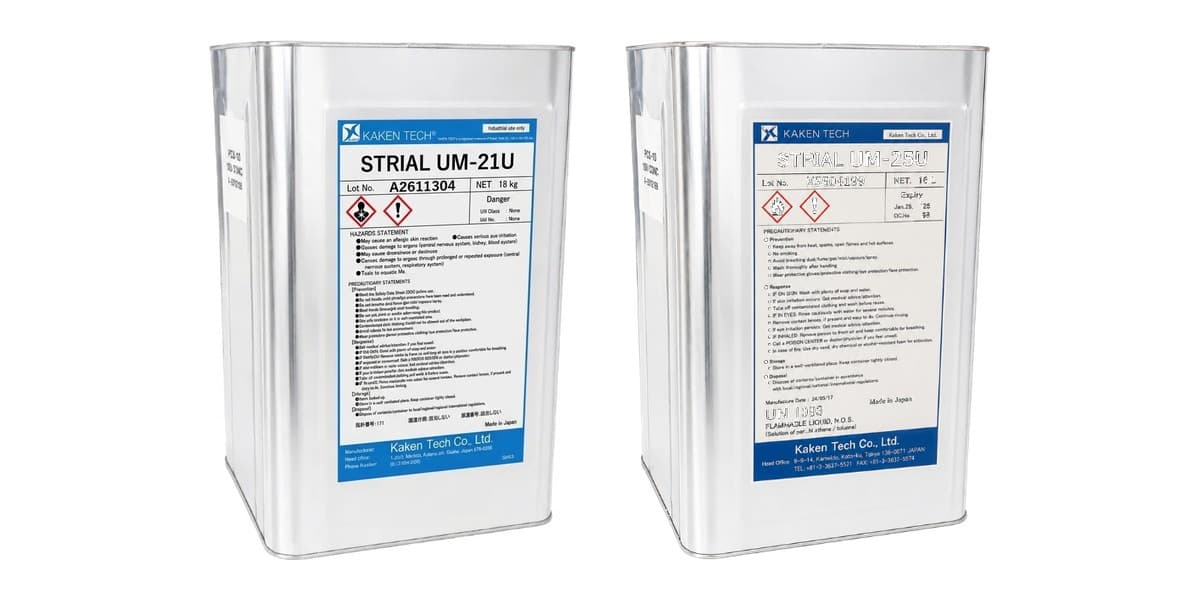
A swelling coating remover. UM-21U is neutral, for aluminum jigs and thin parts, at 60–90°C. UM-25U is mildly alkaline, for steel jigs, and also for resist, ink, and molds, at 70–90°C. Both are stocked in Thailand.
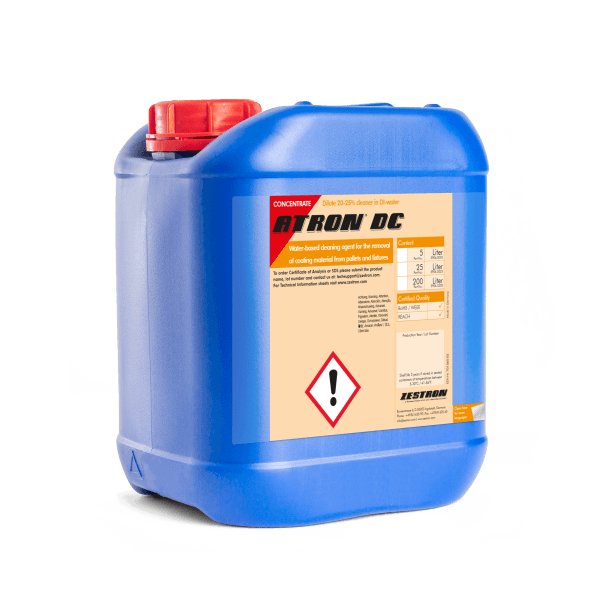
A water-based coating remover. Dilute the concentrate to 20–25% with deionized water, and run it from room temperature to 60°C. It covers acrylic, polyurethane, epoxy, and silicone.
| Grade | Jigs | Parts | Resist | Ink | Molds | pH | Al | Cu | Fe | SUS | Ni plating | Temperature |
|---|---|---|---|---|---|---|---|---|---|---|---|---|
| STRIAL UM-21U / UM-25U | ○ | ○ | UM-25U only ○ | UM-25U only ○ | UM-25U only ○ | UM-21U neutral, UM-25U mildly alkaline | UM-21U ○, UM-25U △ | ○ | UM-21U △, UM-25U ○ | ○ | ○ | UM-21U 60–90°C, UM-25U 70–90°C |
| ATRON DC | ○ | — | — | — | — | Neutral (10 g/L) | Check | Check | Check | Check | Check | Room temperature to 60°C |
STRIAL UM-21U and UM-25U are outside the Fire Service Act, the Industrial Safety and Health Act (organic-solvent rules), the Poisonous and Deleterious Substances Control Act, and PRTR (KAKEN TECH product list, 2019 edition). ATRON DC as a diluted bath is not a hazardous material. The concentrate falls under the fire-service rules.
○ suitable / △ conditional / × not suitable / - not the target / — not stated in the technical note
Steel jigs start with UM-25U (Fe ○). Aluminum jigs start with UM-21U (Al ○). Where both metals share a line, a free coating removal test decides. Check material compatibility before using ATRON DC.
ATRON DC
A water-based coating remover for coated frames, jigs, and pallets. It is not a harsh stripping chemical. It can lift a part of the film, or the whole frame or pallet in a bath.
It is used on acrylic, polyurethane, epoxy, UV-cured, and parylene coatings, in immersion, ultrasonic, and spray maintenance cleaners.
Coating type and result
| Coating | Result |
|---|---|
| Acrylic | Excellent |
| Polyurethane | Good |
| Epoxy | Good |
| Silicone | Fair |
The grades follow the chart in the Zestron technical note dated 5 June 2026. Paint and film thickness change the result, so a free coating removal test is the check.
Brands
 KAKEN TECH products
FIDEA is an authorized distributor. Ask us for the SDS and technical notes.
 Zestron products
The Zestron range, including ATRON DC. Stocked in Thailand.
Coating removal videos
Questions
- Can e-coat (EDP) film on a fixture be removed?
- E-coat film drops current once it insulates the fixture. Whether it can be removed depends on the resin and the thickness. A free coating removal test on one or two jigs shows whether STRIAL fits.
- How is this different from incineration or blasting?
- Incineration and a fluidized bed go to about 450°C, so a jig can warp. Shot blast cuts the surface. STRIAL swells the film and removes it, without incineration and without blast.
- Can it be used on aluminum jigs?
- Yes. Choose the grade. UM-21U is neutral and suitable for aluminum (○). UM-25U is conditional (△). A thin spring or an aluminum jig is checked with a free coating removal test before the grade is chosen.
- What happens to the waste?
- Lifted paint and spent bath follow the factory’s waste rules. It is not chlorinated-solvent waste. Confirm the classification with the local disposer, with the SDS attached.
- Is there stock in Thailand?
- The STRIAL coating remover is stocked in Thailand. Replenishment is arranged from Bangkok. Quantity is confirmed when you ask.
- We wipe paint off jigs with ethyl acetate. Can we switch?
- It depends on the paint. Ethyl acetate is controlled under Japan's Fire Service Act (Class 4, Petroleum Class 1), the Organic Solvent Poisoning Prevention Rules (Class 2), and the Poisonous and Deleterious Substances Control Act (deleterious substance). STRIAL is outside those rules, and the bath is held at 60–90°C. Tell us the paint and the jig material, and a free coating removal test compares the result with ethyl acetate.


Request a free coating removal test
Send one or two paint jigs, hangers, or EDP fixtures. We remove the coating, send them back, and propose the grade for the tank on site.